
Still Figuring it Out.
on graduation and life ahead.

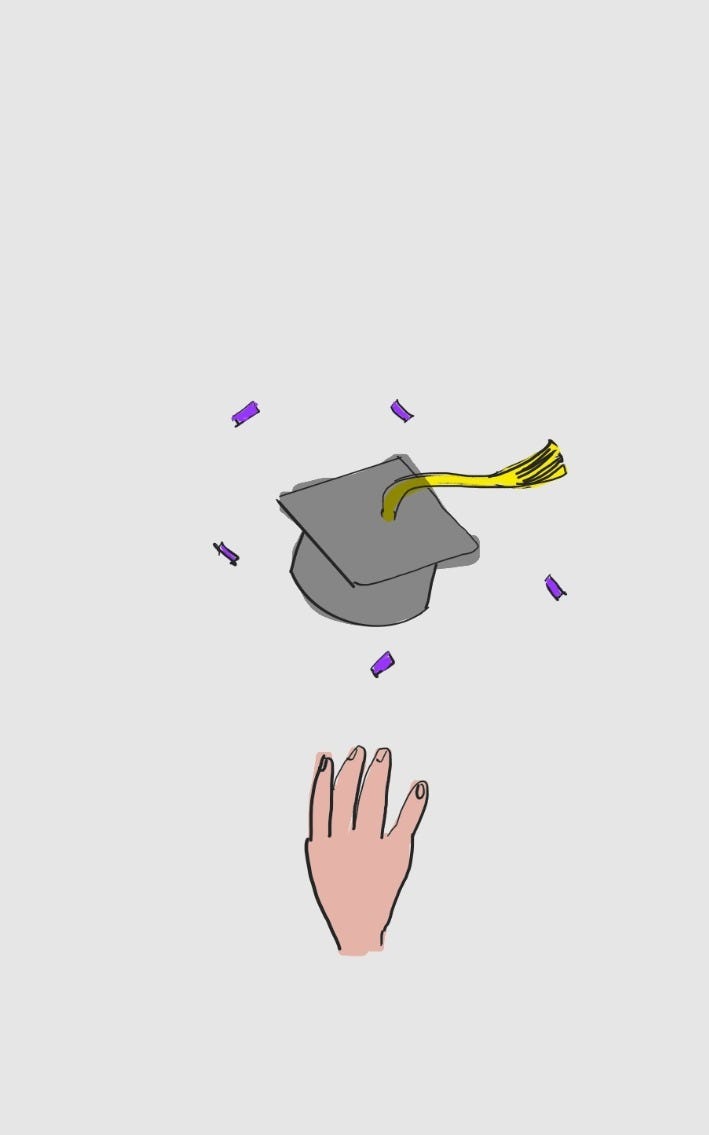
Transitions. This word has been a source of fascination lately. It conjures up the image of a passage, as in ‘transit’, like a fragile timber bridge precariously dangling between two huge blobs. Sometimes it just feels like a huge cloud of mist with phrases like “What plans now?” floating around in it. I know where I have come from. But where I’m being led remains uncertain.
And, I have been toying around with this question ever since my freshman year, when I kept on trying different imaginations in permutations and combinations of a post-graduation life. Yet, I have never felt settled anywhere. This feeling of a lack of settling is perhaps the source of the uncertainty I’m tussling with right now. I’m still in the “figuring it out” phase, and that complicates the neat binary between college life and post-college life. Hence, the idea of ‘transitions’ has never felt as straightforward to me, even though the word itself seems to demand a clean movement from one state to another.
In many ways, though, I’ve been fortunate enough. I have kind and supportive parents. Like my mom, who often keeps on saying that I’m too young to be worrying about a career and job, and that I should probably continue studying, even if I sometimes differ. According to her, this “phase” is a period of learning that is basically preparing me for everything that comes with adulthood— feeling unsettled, having too many emotions at the same time, figuring out, and the burden of making endless decisions. She keeps on reassuring me that things will take their own course, and I’ll get everything that I’ve ever wanted because she has an adorable belief that October-borns usually struggle for the things they want, but somehow find their way to them in the end.
There is also a certain solace in the company of people who understand you—people with whom you feel deeply connected, even if you are not constantly around each other. Sometimes even the lightest conversations with them feel grounding. One of my friends once told me that for people aspiring toward non-linear career paths, like myself, things are rarely straightforward in the way they might appear for others in corporate spaces. We wait for the right opportunities; we keep trying instead of settling for things below our calibre. He once narrated a story of a friend who, despite having an accomplished career in the social sector, still faced repeated rejections from PhD programs. While that unsettled me, realising how academia often undervalues field experience, it was also strangely reassuring. I often joke with him now, “Hum sab ek hi kashti mein hain.”
Sometimes, the mere presence of certain people is enough to keep your ontological self intact. There is a friend who continues to guide and console me through the exhausting deluge of job applications, sometimes even forcing me out of my shell and into the chaos of Delhi, just so I can breathe a little. They are always only a call away.
Another friend reminded me of the strange power of manifestation. They tell me to imagine the life I want in its fullest form— like to imagine the email I have been waiting for, the salary, the work, the lifestyle. They often share stories of how they once moved through a similar phase in life, and how things eventually unfolded almost exactly the way they had imagined. I am deeply grateful for friendships like these.
And then, on a random Thursday last week, I finally received my degree.
For almost three weeks, I had been thinking constantly about endings. We spent Senior Week at Ashoka playing silly games, dancing late into the night with friends and batchmates, trying to hold onto time a little longer. Then we went to Goa, where it felt like the entirety of Ashoka had boarded the same flight. And then, on an otherwise normal Thursday, I walked across the stage, was instructed to pass behind the Vice Chancellor—otherwise I apparently won’t receive my degree—accepted it, smiled for the photograph, and graduated.
Just like that, something that had once felt distant had ended.
We ritualised our endings by carefully marking all the “lasts.” We spent nights absorbing and contemplating our final moments at Ashoka. There was, for instance, a small breakfast ritual my friend and I had developed that, after breakfast, we would walk to the tapri outside campus, no matter the scorching heat, sit beneath the neem tree, and drift into conversations about life, mythology, and imaginary future rucksack trips. Thankfully, we encountered pleasant weather on most of these days.
Yet amidst all this, I could not strangely truly feel present. It was as if I had lost my moorings. It felt as if events kept unfolding like a sequence of images in a reel, and I existed merely as a viewer watching them pass. People kept asking me how I felt about college ending, and my response turned into a rehearsed script: “Right now, I’m feeling too many things at once, and it’s difficult to pick and feel something.”
Toward the end, I even began wondering whether I had lost my capacity for nostalgia itself. Or perhaps I was merely postponing it. But can emotions be delayed? And if they can, then what remains of the human self, just a dry mass moving mechanically through life? I often wonder whether, for Gen Z especially, postponed affect has become a survival mechanism. We live under enormous anxieties like AI, climate collapse, doomscrolling, failed governance, and endless uncertainty. Perhaps intellectualising emotions from a distance feels safer than inhabiting them fully. It has almost become aesthetic to analyse feelings instead of surrendering to them.
But eventually, the defence wall did collapse.
As I began saying goodbye to my friends and to four years at Ashoka, I cried. I cried a lot while hugging people. For me, it was not just about leaving a campus. It was the people, the red Ashokan bricks, the comfort, the familiarity— the idea of home itself. It was here that I discovered an individual self and slowly nurtured it into existence.
Being a student had become central to my identity. And now that I have lost that tag, I find myself asking once again: Who am I without it?
And so, I return to words like “transitions” and “feelings,” still trying to understand what they really mean.